If you’re searching for the signs of autism, you might be doing so with a mix of curiosity, concern, and hope. Maybe you’re noticing traits in yourself, your child, or someone you care about. Maybe you’ve felt “different” your whole life and want language for your experience. Or maybe you’re simply trying to understand autism beyond stereotypes.
Whatever brought you here, you’re not alone, and you’re not too late to understand.
Before anything else:
Understanding signs of autism is not about labeling yourself or someone else.
It’s about clarity, compassion, and access to the right support.
This guide covers:
This article is educational, not diagnostic, but it may help you decide if seeking an evaluation feels right.
These are patterns, not checklists.
Autism is a spectrum, not from less to more, but from variant to variant.
Autistic communication isn’t broken; it’s just different from what many people expect.
May look like:
Most autistic people want connection; they just experience it differently.
Autistic nervous systems may interpret sensory input differently.
Sensory sensitivity examples:
Sensory seeking examples:
These are neurological responses, not preferences.
Also known as special interests, these passions can be:
This isn’t “obsession.”
It’s connection and brilliance.
Stimming is repetitive movements or sounds used to regulate energy, emotions, or sensory input.
Examples:
Stimming is a self-regulation tool, not a problem to correct.
Autistic people may feel emotions:
This may look like
It’s not drama; it’s neurological processing.
Executive function is the brain’s planning system.
Autistic people may struggle with:
This is often mislabeled as lazy, but it isn’t.
Masking is hiding autistic traits to avoid judgment.
Common in:
Masking is survival, not dishonesty.
But long-term masking can lead to burnout, identity confusion, and mental health challenges.
These extend beyond clinical checklists into lived experience.
They appear often but are rarely discussed.
The brain may take longer to interpret speech or sensory sound.
Examples:
Difficulty noticing internal signals like:
Sometimes called alexithymia when related to emotions.
A state of physical, emotional, and cognitive exhaustion.
May include:
The brain prefers one focus at a time, not multitasking.
Not inflexible efficient.
A strong moral compass with low tolerance for:
Often misunderstood as “rigid,” actually values-driven.
After socializing:
Socializing is work, even when enjoyed.
Knowing what to do but not intuitively knowing when to apply it.
Example:
“You should be confident!” → Where? When? How? What does confidence look like here?
Repeating phrases or practicing scripts to:
This is adaptive not “childish.”
Many autistic people discover themselves later in life because they learned to survive before they learned to become.
This is especially true for:
Living in a world not designed for your neurology is tiring.
Common experiences:
A more compassionate way to think about autism traits:
| Letter | Focus |
| S | Social Communication |
| E | Emotional Processing |
| N | Neuro-Sensory Responses |
| S | Special Interests & Focus |
| O | Organization Patterns |
| R | Regulation Tools (meltdowns, stimming, shutdowns) |
Print it. Share it. Take it to therapy.
This framework is meant to clarify, not confine.
| Children | Adults |
| Play differences | Masking + burnout |
| Sensory overload | Identity confusion |
| Trouble with transitions | Executive function stress |
| “Shy / picky / stubborn” labels | “Difficult / intense / sensitive” labels |
Many adults are missed because they learned to adapt, not because they are not autistic.
Autism doesn’t exist in a vacuum it exists within:
This is where culturally competent therapy matters.
This is where P.S. It’s Counseling stands out.
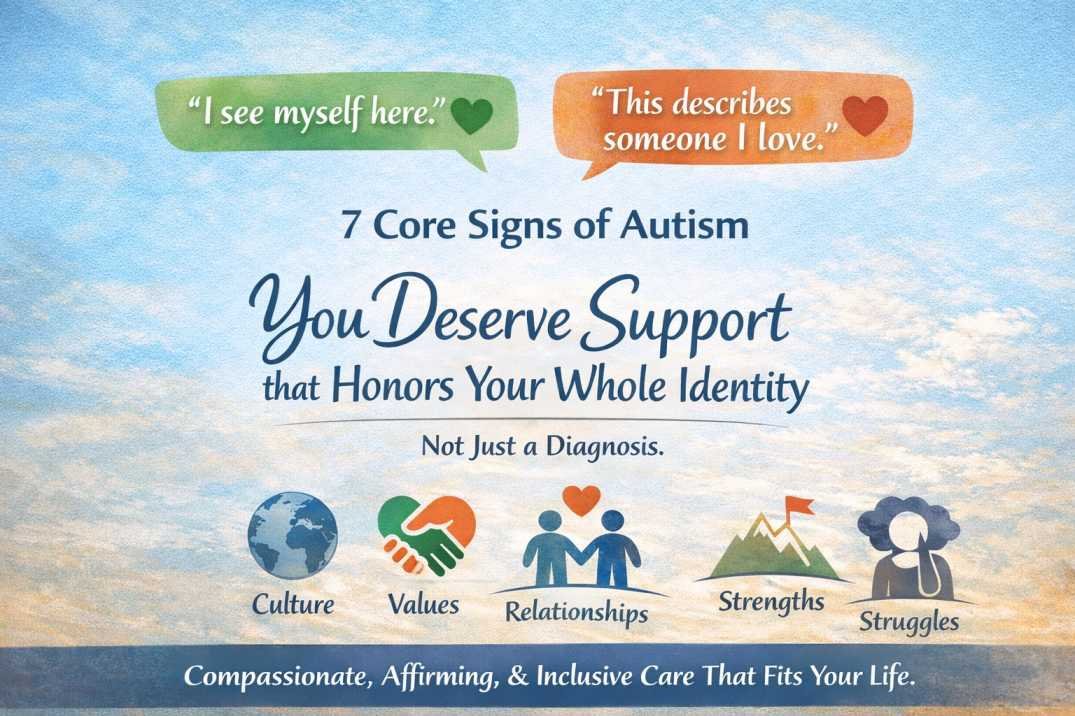
Recognizing the reader’s potential identification with the text, the author emphasizes the importance of receiving support that encompasses the entirety of an individual’s identity rather than focusing solely on a specific diagnosis. This acknowledgment underscores a holistic approach to care and support.
Founded by Payal Sud, LCSW, P.S. It’s Counseling offers a therapy experience that is:
Embark on a transformative path to optimal well-being with our uplifting counseling services. Let our expert guidance elevate you to new heights of wellness. Take the first step today and enjoy a complimentary 15-minute consultation to explore the positive changes awaiting you.