
Concierge therapy and traditional therapy can both provide professional mental health treatment, but they differ in how care is structured, scheduled, and accessed. Traditional therapy usually follows a standard appointment and payment structure while concierge therapy provides greater flexibility, personal attention and direct communication.
Even during the therapy itself, a variety of evidence-based techniques can be used, including cognitive behavioral therapy, dialectical behavior therapy, acceptance and commitment therapy, and relational therapy.
There’s not necessarily a type of therapy that is always better. The difference is the level of access, flexibility, privacy, and personalization built into the care model.
Concierge therapy is a personalized model of mental health care designed around a client’s schedule, preferences, and treatment needs. Depending on the therapist, it may include flexible appointment times, longer sessions, direct communication between appointments, virtual or in-home sessions, and a private-pay arrangement.
Unlike a specific psychotherapy technique, concierge therapy describes how therapy is delivered. A therapist may use the same clinically appropriate treatment methods with a concierge client that they would use in traditional therapy.
At PS It’s Counseling, concierge therapy is designed for individuals, couples, and professionals who value flexibility, privacy, personalized care, and enhanced access to their therapist.
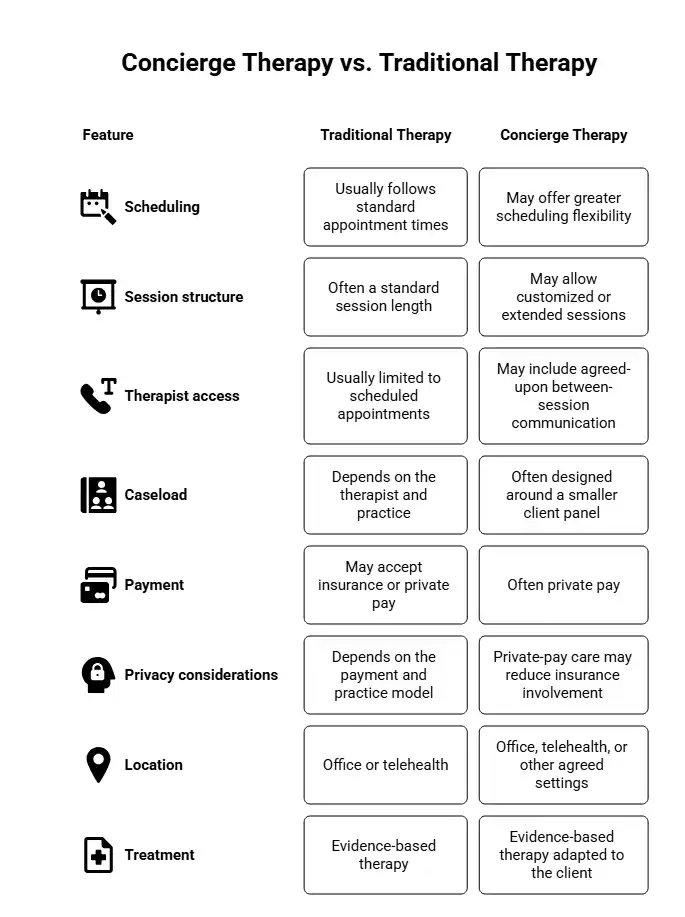
The biggest differences usually involve access and structure rather than the basic purpose of psychotherapy.
| Feature | Traditional Therapy | Concierge Therapy |
| Scheduling | Usually follows standard appointment times | May offer greater scheduling flexibility |
| Session structure | Often a standard session length | May allow customized or extended sessions |
| Therapist access | Usually limited to scheduled appointments | May include agreed-upon between-session communication |
| Caseload | Depends on the therapist and practice | Often designed around a smaller client panel |
| Payment | May accept insurance or private pay | Often private pay |
| Privacy considerations | Depends on the payment and practice model | Private-pay care may reduce insurance involvement |
| Location | Office or telehealth | Office, telehealth, or other agreed settings |
| Treatment | Evidence-based therapy | Evidence-based therapy adapted to the client |
These differences are not universal. Every therapist defines concierge care differently, so clients should ask exactly what access, communication, scheduling, and payment options are included.
Concierge therapy is not necessarily superior to conventional therapy. The choice of the right model is determined by the individual’s clinical requirements, preference, time, budget and access.
Psychotherapy is based on evidence, clinical expertise, relationship and person-centered treatment. According to the American Psychological Association, evidence-based practice is the “best available research evidence, clinical expertise and patient characteristics, culture and preferences.
While increased access and flexibility of therapy through a concierge arrangement is great, so is higher therapy costs only so far as clinical outcomes.
The aspects of the therapist, the therapist/client fit, approach to treatment, and consistent participation are also significant.
The first step in concierge therapy is typically a consultation or intake evaluation. The therapist gets to know the client’s concerns, goals, history, scheduling requirements and preferences.
This therapist thus designs a suitable therapeutic plan. The plan can involve weekly sessions, more frequent sessions, longer sessions, virtual therapy or communication between sessions.
The manner of it differs from practice to practice.
The PS It’s Counseling model of the concierge service is a personalised consultation, customised care planning, flexible scheduling, priority access, and personalised therapeutic relationship.
Some concierge chiropractors provide communication between their scheduled visits. This can be secure messaging, a phone call or a short check-in.
But the direct access does not always imply unlimited or round the clock access.
An effective concierge therapy contract must have clear response times, communication protocols, between-session communication guidelines and what to do during a mental health emergency.
Concierge therapy should never be treated as a substitute for emergency psychiatric or crisis services.
Concierge therapy may work well for people whose schedules do not fit traditional weekly appointment times. Evening, weekend, virtual, or customized appointments may be available depending on the therapist.
This can reduce practical barriers that cause people to postpone or miss therapy.
Concierge therapy allows the therapist to structure care around the individual’s needs rather than relying only on a standard appointment format.
Personalization can include session frequency, communication preferences, treatment goals, and the setting in which therapy takes place.
Consistent contact with the same therapist can help maintain continuity. This can be particularly useful when someone is managing ongoing stress, relationship problems, burnout, trauma-related concerns, or major life changes.
NIMH notes that psychotherapy can address concerns including long-term stress, relationship problems, grief, anxiety, depression, and other mental health symptoms.
Many concierge practices use a private-pay model. When insurance is not used, the treatment may involve fewer insurance-related administrative requirements.
However, clients should not assume that concierge therapy means unlimited or absolute privacy. Mental health professionals still follow applicable confidentiality requirements and legal exceptions.
For virtual care, HHS recommends using a private setting, secure devices, and appropriate privacy practices during telebehavioral health appointments.
Concierge therapy may also be provided through secure telehealth. Telebehavioral health can improve convenience and access, particularly for people who have difficulty traveling or need care that fits around work and family responsibilities.
Concierge therapy may be a good fit for people who:
It can also appeal to professionals, entrepreneurs, caregivers, parents, and individuals managing demanding personal or professional responsibilities.
The important question is not whether someone has a particular job or income level. It is whether the structure of concierge therapy matches their needs.
Traditional therapy may be the better option when a person:
A standard therapy arrangement can provide high-quality, evidence-based treatment. Concierge care should not be presented as a replacement for traditional therapy.
Yes, it can.
Concierge therapy is not a therapy, but a way of delivering therapy. Evidence-based techniques can be applied by a qualified therapist in a concierge practice.
Therapy options include cognitive behavioral therapy, dialectical behavior therapy, acceptance and commitment therapy, relational therapy, interventions using mindfulness techniques and other clinically appropriate therapies, depending on the client’s needs and the therapist’s training.
The type of psychotherapy used can vary by therapy, professional preparation, and person’s needs, NIMH notes.
The American Psychological Association also stresses the importance of using research evidence, clinical expertise, and personal preferences in delivering psychological care based on evidence.
Concierge therapy may be worth the additional cost for someone who places high value on flexibility, privacy, continuity, and enhanced access.
However, the higher price does not automatically mean better treatment.
Before choosing concierge care, ask:
If you are paying for care yourself, ask about expected costs before treatment begins. CMS provides guidance regarding Good Faith Estimates for people who are uninsured or choose to self-pay for health care.
Also Read: Concierge Therapist Chicago Cost Benefits and How It Works
Often, the best argument for concierge therapy is its organization of care.
It can make therapy more convenient, and can give a greater one-to-one access to a therapist. However, it should not be used as a substitute for evidence-based treatment, professional boundaries, clinical assessment or an appropriate therapeutic relationship.
Many people can do very well with traditional treatment. Concierge therapy might be a more appropriate option if flexibility, privacy, continuity, and access are paramount.
Concierge Therapy, at PS It’s Counseling, is based on the client’s schedule, preferences and treatment objectives, and seen with a professional treatment of mental health care.
If you’re wondering about something more flexible and customized to your therapy experience, reach out to PS It’s Counseling to see if concierge therapy is a good choice for you.
Mental health treatment can be effective in either a concierge therapy or traditional therapy setting. The major distinction is the approach to the organization of care. The main difference between concierge therapy and traditional therapy is the flexibility, customization, continuity and access that are provided when it comes to appointments and payment.
The selection is dependent on your clinical needs and schedule, preferences, budget and the therapist you select. Concierge therapy at PS It’s Counseling is a customizable and personalized treatment that’s better for people, couples, and professionals who prefer a therapy that better fits into their life.
Concierge therapy is a personalized mental health care model that may provide flexible scheduling, enhanced therapist access, customized sessions, and private-pay options.
The main difference is the structure of care. Concierge therapy may provide more scheduling flexibility, customized session options, and agreed between-session communication, while traditional therapy generally follows a standard appointment model.
Not necessarily. Concierge therapy may offer greater convenience and access, but clinical quality depends on the therapist, treatment approach, therapeutic relationship, and the client’s needs.
It may be worthwhile for people who value flexibility, privacy, continuity, and additional access. The value depends on the services included and the client’s individual needs.
Some concierge therapists are private pay only, while others may offer superbills or different payment options. Ask the provider about insurance and reimbursement before starting treatment.
Yes. Some therapists provide concierge therapy through secure telehealth platforms. Online therapy can improve convenience and access for people who cannot easily attend in-person sessions.
No. Some concierge therapists provide between-session communication, but access and response times depend on the provider’s policies. Concierge therapy does not automatically provide 24-hour crisis care.
It may suit people with demanding schedules, frequent travel, strong privacy preferences, or a need for more flexible and personalized therapy access.