Autism can feel like a word loaded with questions especially for parents, caregivers, and even autistic individuals themselves. One of the most common questions people search online is:
It’s an important question. And you deserve an honest answer that doesn’t overwhelm you or point fingers.
So let’s start with clarity:
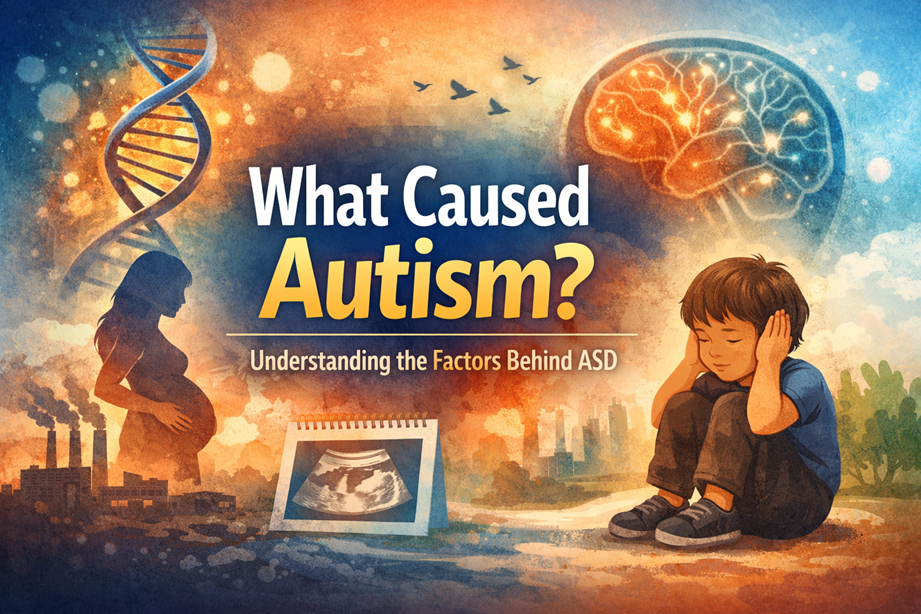
Current research shows autism develops from a combination of influences, most of which occur before birth or in early life, shaping how the brain grows and processes the world.
These influences include:
Understanding these contributors isn’t about blame, it’s about education, empowerment, and compassion. That’s the heart of this article.
Autism is caused by a mix of genetic and environmental influences that affect early brain development. No single factor “creates” autism on its own, and nothing a parent did or didn’t do has been proven to cause autism.
In simple terms – Autism typically starts before birth, influenced by biology, not by parenting or lifestyle.
Also Read: How To Find a Good LGBTQ Friendly Therapist
You’ve probably heard the phrase “autism is a spectrum.” This means each autistic brain is uniquely wired and so are the origins of their autism.
Think of autism like a mosaic: different tiles (genes, biology, pregnancy factors) come together to shape a person’s neurological profile.
Some individuals show strong genetic roots. Others show environmental patterns. Most show a blend.
This is why saying “X causes autism” oversimplifies something much more complex and much more human.
This matters especially online, where misinformation spreads fast.
| Term | What It Means | Example |
| Cause | Directly creates an outcome | ❌ No single known cause of autism |
| Risk factor | Raises the likelihood, not a guarantee | Premature birth |
| Correlation | Seen together, but not proven connected | Air pollution + autism rates in some cities |
Keeping these distinctions in mind helps us avoid confusion and blame.
Research shows genetics play the biggest role in autism. This doesn’t mean autism is always inherited but genes influence how likely autism is to appear.
This is why genetic testing can be helpful for some families (and why clinicians sometimes recommend it).
Also Read: What Is Cognitive Behavioral Therapy
Autistic brains aren’t “damaged” they’re different.
Those differences often appear:
Neuroscience has found variations in:
These differences shape behavior, communication, learning styles, and sensory experiences the traits we associate with autism.
Again, these are not causes, but associations that may influence likelihood.
Factors researchers are studying include:
These factors don’t mean “autism will happen” simply that they may add a puzzle piece to the picture.
Autism doesn’t suddenly appear at age 3, 6, or 10. It’s not caused by screen time, “bad behavior,” or emotional stress.
Most influences happen before birth or shortly after.
| Period | What Can Influence Risk | What We Know |
| Before pregnancy | Family genetics, parental age | Can shape likelihood |
| During pregnancy | Brain development, medical factors | Crucial developmental window |
| At birth | Complications affecting oxygen | Sometimes linked |
| After birth | Learning environment and support | Does not cause autism |
This timeline supports an essential truth:
Autism is not caused by parenting.
Autism is not caused by trauma.
Autism is not caused by technology or screens.
Period.
Let’s make this clear boldly and kindly:
These have been thoroughly discredited by decades of scientific study.
However… vaccines and autism are often discussed together because the timing of childhood vaccines overlaps with the typical age of autism diagnosis. That overlap is coincidence, not causation.
Vaccines protect, not harm.
People often assume rising numbers = autism is becoming more “common.”
But that’s not the full story.
What’s actually rising is:
In other words: We’re noticing autism more, not creating more autism.
Science has learned a lot but there’s more to uncover.
Ongoing research is exploring:
Uncertainty isn’t failure, it’s honesty. And honesty builds trust.
If you came here wondering “What caused autism?” I hope you leave with something gentler and more grounded.
Autism forms through:
genetics
brain development
prenatal influences
And none of these are anyone’s fault. Understanding causes isn’t about regret or “fixing” someone. It’s about support, visibility, and choices moving forward.
If you or someone you love is autistic, support matters more than origin stories. Compassion matters more than certainty. Humanity matters more than any diagnostic label.
If you’re seeking a place that looks at autism beyond labels, a place that sees the whole person, not just a spectrum score, consider P.S. It’s Counseling.
Founded by Payal Sud, a Licensed Clinical Social Worker, cultural bridge-builder, and passionate advocate, this practice offers support that meets people where they are neurologically, emotionally, culturally, and spiritually.